AI Test Case and Requirements Generator with TestCaseLab

Turn Product Context into Review-Ready QA Artifacts

Writing Test Cases and Requirements from a blank page takes time. The TestCaseLab AI Assistant helps QA teams prepare structured first drafts using natural language and the context available in their current project.

Describe a feature, user flow, business rule, or testing objective. The AI Assistant prepares Test Cases or Requirements for your review, allowing you to edit and approve the content before it becomes part of the project.

From Product Context to Ready-to-Review QA Assets

See how TestCaseLab AI Assistant helps teams turn prompts, project Requirements, and supporting materials into structured Test Cases and Requirements ready for review.

01

Generate Test Cases from Prompts and Attachments

Describe the functionality or scenario you need to test, or attach supporting files containing the relevant product context. The AI Assistant will use your instructions and the provided content to prepare structured Test Cases.

You can provide:

  • Feature or module descriptions.
  • User flows and business rules.
  • Preconditions and expected behaviour.
  • Positive, negative, and edge-case scenarios.
  • Priorities and test types.
  • Specifications, screenshots, tables, or structured data in attached files.

The generated Test Cases are displayed in an editable preview before they are saved. You can review the titles, steps, expected results, and coverage, then save the approved Test Cases to the selected project and test suite.

TestCaseLab AI Assistant: Generate Test Cases from Prompts and Attachments.
02

Create Requirements with AI

Turn an initial product idea, business need, or supporting document into structured Requirements.

You can describe or attach information about:

  • Product features and functionality.
  • User goals and expected behaviour.
  • Business rules and constraints.
  • Acceptance conditions.
  • Existing specifications, tables, screenshots, or structured data.

The AI Assistant prepares draft Requirements for review before creation. You can edit the generated content, assign the appropriate categories, and connect Requirements with related Test Cases.

This gives product and QA teams a faster starting point while keeping the final business logic under human control.

TestCaseLab AI Assistant: Create Requirements with AI.
03

Generate Test Cases from Existing Requirements

The AI Assistant can use one or more Requirements already available in the current project as the basis for new Test Cases.

Select the relevant Requirements and add any specific testing focus, such as:

  • Positive and negative scenarios.
  • Edge cases.
  • Regression coverage.
  • Validation rules.
  • Permission or role-based behaviour.

You can also attach additional files when the existing Requirements do not contain all the necessary context.

The AI Assistant prepares Test Cases based on the selected Requirements, your instructions, and any supporting attachments. The generated Test Cases can be reviewed and edited before they are saved to the selected suite.

TestCaseLab AI Assistant: Generate Test Cases from Existing Requirements.

Give AI the Context It Needs

Extend the AI Assistant beyond a short prompt by combining project information with documents, screenshots, structured data, and other supporting files.

Use Documents and Images as AI Context

TestCaseLab AI Assistant: Use Documents and Images as AI Context.

Product context is not always available in a short prompt. Requirements may be stored in specifications, spreadsheets, screenshots, exported data, or other supporting materials.

Attach files directly to the AI Assistant and use their content to:

  • Generate Test Cases.
  • Generate Requirements.
  • Ask questions about documents and images.
  • Clarify business rules, workflows, or expected behaviour.
  • Combine information from multiple supporting files in one request.

Supported formats include:

  • PDF.
  • DOC and DOCX.
  • TXT.
  • CSV.
  • JSON.
  • PNG and JPG.

You can attach up to three files to one message. Each file can be up to 10 MB, with a maximum combined attachment size of 20 MB per message. PDF files can contain up to 100 pages.

The AI Assistant processes the attachments together with your written instructions and displays generated Test Cases or Requirements in an editable preview before saving.

Ask Questions About Projects and Attached Files

TestCaseLab AI Assistant: Ask Questions About Projects and Attached Files.

The AI Assistant is not limited to content generation. It can also help your team understand information stored in the current project or provided through attachments.

Ask it to:

  • Find Test Cases related to a feature.
  • Summarize Test Cases for a particular product area.
  • Find Test Cases with specific tags, priorities, or types.
  • Find Requirements by title, status, type, or tag.
  • Identify Requirements without linked Test Cases.
  • Explain what a Requirement or group of Test Cases covers.
  • Summarize an attached specification.
  • Extract important rules or scenarios from a document.
  • Answer questions about an attached image, table, or data file.

This reduces the time spent manually searching through large projects or reviewing long supporting documents when you need a focused answer.

Keep AI Work Focused and Under Control

Review generated content before saving, keep it focused on the current project, and manage AI access and usage.

Review Every Result Before Saving

TestCaseLab AI Assistant: Review Every Result Before Saving.

AI-generated content should support professional judgment, not replace it.

TestCaseLab shows generated Test Cases and Requirements in an editable preview before they are created. Review the output and confirm that:

  • Titles are clear.
  • Test steps are practical and accurate.
  • Expected results match the intended behaviour.
  • Requirements reflect the correct business logic.
  • Information from attachments has been interpreted correctly.
  • Important positive, negative, and edge-case scenarios are covered.

For generated Test Cases, you can select the appropriate project and suite before saving. For generated Requirements, you can edit the content, assign categories, and link them to Test Cases.

Only reviewed and approved content becomes part of the project repository.

Work with the Context of Your Current Project

The AI Assistant works within the project you currently have open.

This keeps its responses focused on the Test Cases and Requirements belonging to that project instead of mixing information from unrelated testing workspaces.

You can extend the available project context by attaching specifications, screenshots, data exports, and other supporting files to an individual message. The attachments are used together with your prompt and the relevant project information.

Control Access and AI Usage

AI attachments are available to Admins and Members.

Project Viewers and API users cannot upload or use attachments with the AI Assistant. Regular AI Chat without attachments continues to work as before for users with the appropriate access.

AI credits are applied to attachment-based requests in the same way as other AI Assistant actions. Protection against duplicate charges prevents users from being charged again when retrying a failed message.

What Is an AI Test Case Generator?

An AI test case generator is a tool that turns product information into draft testing scenarios, steps, and expected results.

The input may include natural-language prompts, feature descriptions, user stories, acceptance criteria, business rules, existing Requirements, specifications, screenshots, or structured data files. The generated output gives testers a starting point that they can review, edit, and improve.

File attachments make AI-assisted generation more practical when product information is too detailed for a short prompt. Instead of manually copying content from a specification, testers can attach the original document and ask the AI Assistant to generate Test Cases, create Requirements, summarize the content, or identify important testing scenarios.

AI-assisted test generation can reduce repetitive drafting work and help teams consider additional cases. However, generated content still requires human validation because product context, risk, and expected behaviour cannot always be determined correctly from prompts or documents alone.

TestCaseLab combines AI generation with a structured test management workflow. Testers can generate, review, edit, and save Test Cases and Requirements within the same project where they manage test coverage and execution.

Why Use the TestCaseLab AI Assistant?

Faster First Drafts

Move from an initial feature description or supporting document to structured Test Cases or Requirements without starting from an empty template.

File-Based Generation

Generate QA content directly from specifications, documents, screenshots, tables, and structured data.

Requirements-Based Generation

Create Test Cases from the existing Requirements they need to validate.

Project-Aware Assistance

Search and summarize Test Cases and Requirements from the current project.

Questions About Attachments

Ask the AI Assistant to explain, summarize, or extract information from uploaded documents and images.

Human Review Before Creation

Preview, edit, and approve generated content before it enters the QA repository.

Connected QA Workflow

Generate and save content directly where Requirements and Test Cases are managed instead of copying results from a separate AI tool.

AI Assistant FAQ

What can the TestCaseLab AI Assistant generate?

It can generate Test Cases and Requirements from natural-language instructions, existing project Requirements, and attached files.

Can it generate Test Cases from existing Requirements?

Yes. You can ask the AI Assistant to create Test Cases based on one or more Requirements from the current project. You can also add attachments when more context is needed.

Can I generate Test Cases from a file?

Yes. Attach a supported document or image, describe what you need, and review the generated Test Cases before saving them to the selected project and suite.

Can I generate Requirements from a file?

Yes. The AI Assistant can generate Requirements from attached files. You can edit the results, assign categories, and link the Requirements to Test Cases before saving.

Which attachment formats are supported?

The AI Assistant supports PDF, DOC, DOCX, TXT, CSV, JSON, PNG, and JPG files.

How many files can I attach?

You can attach up to three files to one message.

What are the attachment size limits?

Each file can be up to 10 MB. The combined size of all attachments in one message cannot exceed 20 MB.

Is there a limit for PDF files?

Yes. PDF files can contain no more than 100 pages.

Can I ask questions about attached files?

Yes. You can ask the AI Assistant to summarize a document, explain its content, identify business rules, extract testing scenarios, or answer questions about attached documents and images.

Does the AI Assistant save generated content automatically?

No. Generated Test Cases and Requirements are displayed in an editable preview before they are created.

Can I edit AI-generated content?

Yes. You can review and refine the generated content before confirming that it should be saved.

Can the AI Assistant search existing Test Cases?

Yes. You can ask it to find or summarize Test Cases using information such as feature, title, tags, types, or priorities.

Can it identify Requirements without Test Cases?

Yes. The AI Assistant can help find Requirements that do not have linked Test Cases.

Does AI replace the tester’s review?

No. AI provides drafts, summaries, and suggestions. The user remains responsible for validating their accuracy, relevance, and coverage.

Turn Product Context into Structured QA Content

Use prompts, existing Requirements, documents, images, and structured data to generate Test Cases and Requirements your team can review and save directly in TestCaseLab.

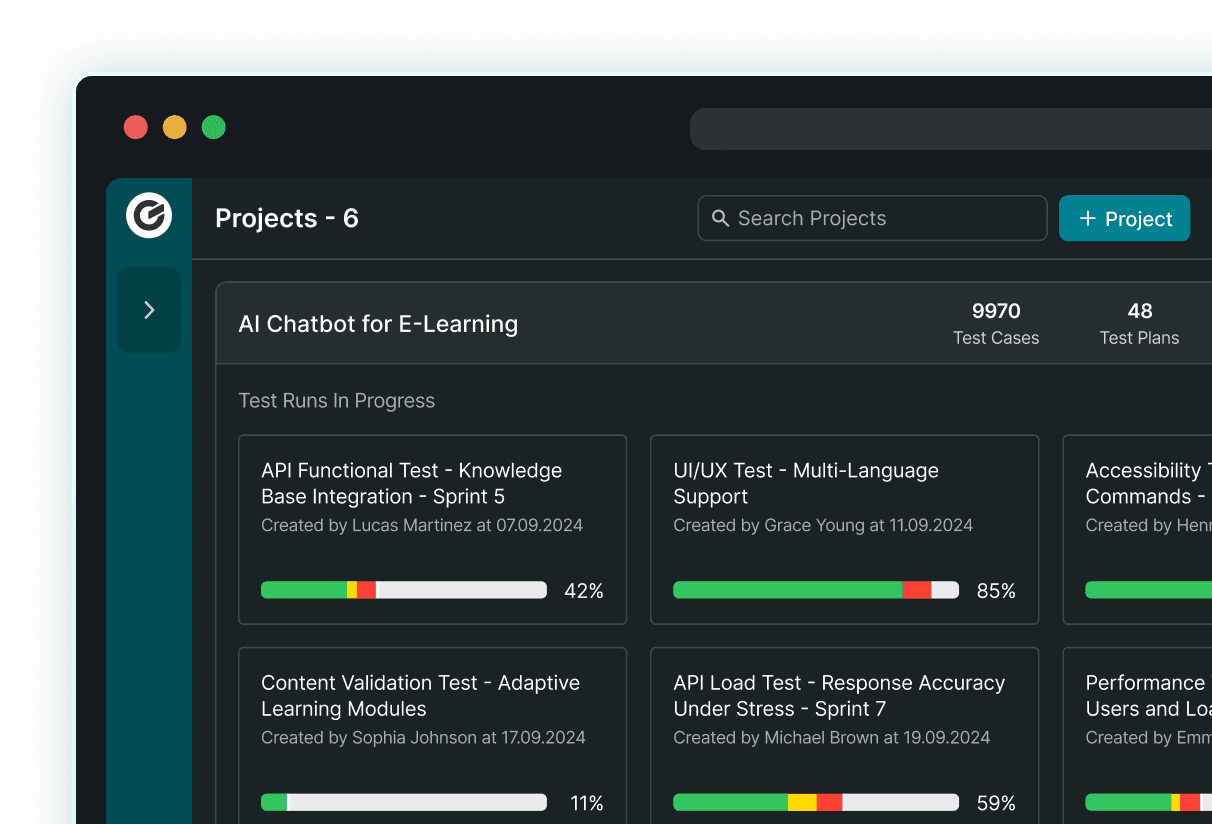
Dark TestCaseLab Projects dashboard showing project counts and test run progress.